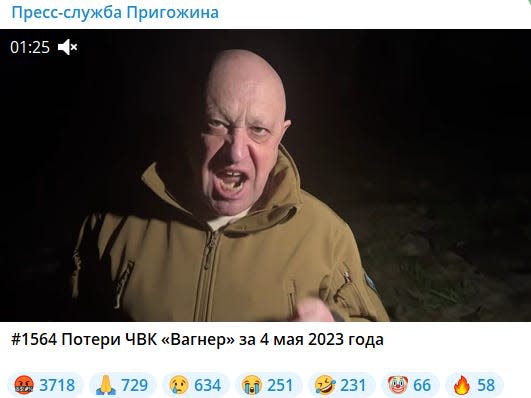
Last weekend all the world talked about the Wagner Group rebellion headed by Yevgeny Prigozhin. It was difficult to say what was more unexpected, the beginning of the so-called “March for Justice” or its abrupt end. Everyone was mystified. What was Prigozhin’s aim? Why did the march stop 200 km from Moscow? What kind of deal was brokered by Belarus’ dictator Lukashenko? How dangerous would Prigozhin be if he got hold of the Russian nuclear arsenal?
Quite a few things become clear if one listens to Prigozhin’s audio and video messages on Telegram. First of all, we can conclude that the main reason for the rebellion was the plan of the Ministry of Defence to take control of PMC Wagner from July 1. Without the group, Prigozhin’s life was not worth a kopeck. As soon as Lukashenko offered his guarantees for Prigozhin and the Wagner Group, the rebels stopped, saying that they did not want Russian blood to be spilled. Prigozhin was fighting for his life and his company’s survival, first and foremost.
Moreover, Prigozhin used Telegram to boost his political weight and his price in the negotiations. In his messages Prigozhin creates the image of a true Russian patriot and a father figure for his soldiers. Perhaps he even believes it himself, like a talented actor who uses Stanislavski’s system. He exploits two feelings deeply anchored in a Russian soul: fear of chaos and loathing for the elite. The fear of chaos produces the longing for a “strong man”, who can keep everything in order. To create this kind of persona, Prigozhin praises Wagner’s achievements and efficiency, greatly exaggerating them. He speaks clearly and energetically, presents himself in military outfits and uses a lot of military slang and abbreviations to appear as an experienced commander: vertushki ‘helicopters’, BK ‘combat kit’, ptichka ‘drone (lit. little bird)’, na zemle ‘in the field’ and others.
To satisfy the Russians’ deep loathing for the elite, Prigozhin chooses the Ministry of Defence headed by Shoigu and the Chief of the General Staff Gerasimov as his main targets. He refers to them and their clique with very strong negative words: mrazi ‘scums’, tvari ‘beasts’, nedoumki ‘imbeciles’, klouny ‘clowns’, psixičeski bol’nyje ‘mentally ill’, and so on, blaming them for the military losses and the ruined prestige of the Russian army. For example:
Original: Psixičeski bol’nyje podonki, psixičeski bol’nyje paskudy rešili, ničego strašnogo, my kinem na mjaso ešče neskolko tysjač russkix parnej.
Translation: ‘Mentally ill bastards, mentally ill scoundrels decided, no big deal, we’ll use a few more thousands of Russian boys as cannon fodder.’
Original: Sborišče etix mrazej, ponimaja o tom, čto oni uže prosrali kolossal’nyj kusok territorii, soberutsa i zajavat o tom, čto oni peregruppirovalis’ na bolee vygodnyje pozicii.
Translation: ‘A bunch of these scum, realizing that they have already pissed away a colossal piece of territory, will gather and declare that they have regrouped to more advantageous positions.’
https://t.me/Prigozhin_hat, 23.06.23
In his earlier interview with the blogger Dolgov, Prigozhin talked about the huge gap between the elites, whose children fly to Dubai, and the ordinary Russians, who send their children to die in the war. More recently, he has explained that the invasion started because the greedy oligarchs, generals and officials wanted more and more.
All this is very entertaining, of course. First of all, before the rebellion Prigozhin belonged to the corrupt elite that he criticised so passionately. As for Wagner’s successes, they were created mostly by thousands and thousands of convicts thrown as cannon fodder on Ukrainian trenches. But Russians have always preferred a good show and carnival to integrity and honesty, as we can judge from the popularity of the late Zhirinovsky.
What can make Prigozhin appealing for ordinary Russians is not so much what he says, but how he says it. He speaks like common people. He uses obscene words. He makes occasional errors in grammar and word choice, as in the examples below.
Original: Pogibaja na Baxmute, zaščiščaja čest’ Rossiji i rossijskoj armii, nas podlo obmanuli…
Translation: ‘While dying in Bakhmut, defending the honour of Russia and the Russian army, they deceived us in a vile way [meaning: we were deceived while dying etc.]’.
Original: Poetomu vojna zašla v zatjažnoj xarakter.
Translation: ‘That’s why the war came into the protracted nature‘.
Original: Poetomu my posčitali, čo demonstracija togo, čto my sobiralis’ sdelat’,
onadostatočna.Translation: ‘That’s why we reckoned that the demonstration of what we were going to do,
https://t.me/Prigozhin_hat, 23.06.23 and 26.06.23itwas sufficient’.
To conclude, I believe that Prigozhin was forced to act, in order to save his life and his business. His militaristic anti-elite messages are a carefully engineered show serving to increase his political weight and ensure his supporters’ loyalty. Perhaps he never expected to get so close to Moscow without any resistance, exposing the weakness of Putin’s regime. But if he had grabbed that chance and taken the Kremlin, I honestly doubt that he would have been more dangerous than Putin.

 Text Grinder